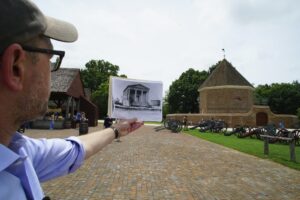
Allen G. Breed/AP
A Confederate soldier identification effort at Colonial Williamsburg could soon restore a name to one of four men whose remains were discovered near a former Civil War hospital.
WILLIAMSBURG, Va. — Researchers could be nearing the identification of a Confederate soldier whose remains were discovered during archaeological work at Colonial Williamsburg, according to a July update published by the James City Cavalry Camp No. 2095.
Five possible descendants have agreed to provide DNA samples for comparison with genetic material recovered from the soldier’s remains. Researchers hope sequencing results could be available in early fall.
The remains are among four sets uncovered in 2023 inside the walls of Colonial Williamsburg’s historic Powder Magazine. Archaeologists also discovered three amputated legs and evidence linking the burial site to a nearby Baptist church that served as a hospital following the Battle of Williamsburg in May 1862.
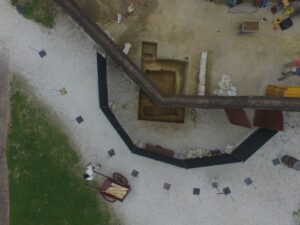
Aerial view of excavation site
Historical records indicate that Confederate soldiers too badly wounded to retreat were treated inside the church after Union forces occupied Williamsburg. Lists preserved in local archives recorded the names, military units, injuries and deaths of more than 60 men treated there.
Those records allowed researchers to narrow the possible identities of the four men to soldiers from Alabama, Louisiana, South Carolina and Virginia.
The current DNA investigation is concentrating on one soldier believed to be the strongest candidate for identification. Genealogical research found that the possible soldier was unmarried but had nine brothers and sisters, giving researchers several family lines through which living relatives could be located.
Researchers identified three possible descendants through the maternal line and four through the paternal line. Five agreed to participate in DNA testing, according to the camp newsletter.
Dr. Raquel Fleskes of Dartmouth College is working to sequence and compare the samples. The July update said sequencing was temporarily delayed while Fleskes evaluates another testing method that could provide more accurate results.
Should that method prove more effective, it will be used to examine DNA extracted from the remains.
Archaeologists previously reported obtaining especially strong genetic material from the soldier under investigation. Additional samples were taken from the teeth of the other three men before their reburial.
The four soldiers were reinterred at Cedar Grove Cemetery in Williamsburg in June 2025. A fifth burial contains bones recovered from what archaeologists identified as a surgeon’s pit.
Space was left on the soldiers’ grave markers so their names and military units can be added should the identification effort succeed.
A confirmed match could also help researchers investigate the other three soldiers. Because several of the men appear to have died and been buried within a short period, identifying one could narrow the remaining possibilities through hospital death records.
The project combines archaeology, military records, census research, genealogy and modern DNA analysis in an effort to restore names to men who have remained unidentified for more than 160 years.
Further results are expected later this year.
Source: July 2026 edition of Picket Lines, published by the James City Cavalry Camp No. 2095, Virginia Division, Sons of Confederate Veterans. Additional background from Colonial Williamsburg and Associated Press reporting.